Antibody-drug conjugates (ADCs) are reshaping the landscape of targeted therapy. Once regarded primarily as a breakthrough in oncology, ADCs—through their precision delivery and potent cytotoxic effects—are now showing impressive potential well beyond cancer. From autoimmune and infectious diseases to metabolic and neurodegenerative disorders, ADCs are emerging as innovative solutions for complex treatment challenges.
ADCs consist of three essential components: a monoclonal antibody that specifically targets antigens overexpressed on cancer cells, a cytotoxic payload and a linker that connects the two. By concentrating the drug on the specific target, ADCs deliver drugs directly to diseased cells or tissues, improving efficacy while minimizing systemic side effects.
Therapeutic Opportunities for ADCs Beyond Oncology
ADCs for Autoimmune and Inflammatory Diseases
In autoimmune disorders, ADCs offer a way to precisely eliminate abnormal immune cells—such as B cells, T cells, or certain inflammatory mediators—without triggering the broad immunosuppression that often comes with traditional therapies.
- 🔹 ABBV-3373: Developed by AbbVie, this ADC links an anti-TNF antibody to a glucocorticoid receptor modulator (GRM). It demonstrated superior targeting and safety in the treatment of rheumatoid arthritis. The program was eventually discontinued, though mainly for strategic reasons rather than issues with efficacy or safety. [1]
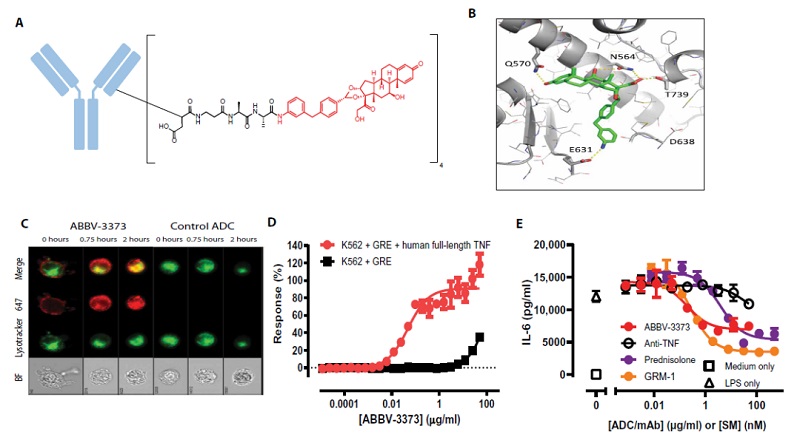
- Figure 1. Structure and characterization of ABBV-3373. Source: reference [1]
- 🔹 Researchers are also investigating ADCs against CD6 and CD45, aiming to selectively deplete pathogenic T cells. These approaches could open up new treatment options for conditions such as lupus and multiple sclerosis.
ADCs for Infectious Diseases
In the fight against infectious diseases, ADCs are beginning to show new promise. Antibiotic resistance has significantly undermined the effectiveness of current treatments for bacterial infections, prompting researchers to explore antibody-antibiotic conjugates (AACs) as a solution. Much like ADCs, AACs use antibodies as carriers to deliver antibiotics directly into bacterial cells, where the drug is then released. This targeted delivery helps limit damage to healthy host cells.
- 🔹 DSTA4637S (RG7861): This AAC employs a monoclonal antibody that binds to wall teichoic acid on Staphylococcus aureus and is linked, via a cleavable linker, to a novel rifamycin-class antibiotic (dmDNA31). Once phagocytic cells engulf the antibody–bacteria complex, intracellular proteases cleave the linker, releasing the antibiotic to kill drug-resistant S. aureus hidden inside host cells. Clinical trials have shown encouraging results, underscoring its potential as a next-generation antibiotic. [2]
- 🔹 In the viral field, researchers are also investigating ADCs designed to target HIV-1 proteins gp41 and gp120, enabling the precise delivery of antiviral agents to enhance therapeutic efficacy. [4]
ADCs for Neurological Disorders
Despite the challenges posed by complex neurological targets and the blood–brain barrier, ADCs are beginning to show early promise in neurodegenerative diseases.
- 🔹 morADC (Morphomer® Antibody Drug Conjugate): At the 2024 Alzheimer's Association International Conference (AAIC), AC Immune presented its ADC candidate, morADC. The technology combines two highly selective molecules, each of which was individually designed to target and disrupt pathological forms of proteins (ie proteinopathies), like Abeta, Tau or a-synuclein (a-syn). The morADC are able to cross the blood-brain barrier more efficiently and offer higher potency than individual parent molecules. [5] Preclinical data have shown that morADC are capable of interacting with validated proteinopathies implicated in neurodegeneration, including Abeta, Tau and a-syn. morDAC enable single or dual-targeting strategies that deliver a combination therapy in a single therapeutic agent and have significantly enhanced anti-aggregation effects compared to the parental molecules alone. These results highlight its potential as a first-in-class and best-in-class therapeutic option. Although morADC is still in the early stages of development and several years away from clinical trials, its outlook is highly promising.
ADCs for Metabolic Disorders
ADC technology is gradually being applied to metabolic diseases such as atherosclerosis, diabetes, and obesity.
- 🔹 Maridebart Cafraglutide (MariTide): Develped by Amgen, it is an antibody–peptide conjugate, or peptibody, which falls under the broader category of ADCs. MariTide is engineered by coupling two GLP-1 receptor agonist peptides to an antibody against GIP (glucose-dependent insulinotropic polypeptide). This creates a three-part structure: the GLP-1 agonists activate GLP-1 receptors to stimulate insulin secretion, while the anti-GIP antibody downregulates GIP activity. Together, these mechanisms work synergistically to achieve controlled weight loss. [5]
- 🔹 Beyond obesity, ADCs are also being developed to target lipid metabolism to address atherosclerosis. For instance, LXR agonist–ADCs are being designed to deliver their payloads directly to lipid pathways, helping to reduce plaque formation and modulate cholesterol levels.
ADCs for Fibrotic Diseases
ADCs are also showing strong potential in the treatment of fibrotic diseases such as pulmonary fibrosis and liver fibrosis. These conditions are marked by excessive tissue scarring, which often leads to organ dysfunction and, in severe cases, organ failure. By delivering drugs directly to fibrotic tissue and modulating fibrosis-related pathways, ADCs provide a targeted therapeutic approach.
- 🔹 Alentis Therapeutics is developing lixudebart, an antibody that targets a unique epitope of CLDN1 exposed in fibrotic tissue, with the goal of reversing organ fibrosis. Lixudebart is currently being evaluated in clinical trials for advanced liver fibrosis. Related ADC candidates are also being explored as potential therapies for idiopathic pulmonary fibrosis (IPF), a chronic and progressive lung disease with no current cure, where existing treatments can only slow disease progression.
- 🔹 In the liver fibrosis setting, ADCs offer the possibility of delivering antifibrotic agents directly to the liver to reduce scarring and prevent progression to cirrhosis. Alentis’ research on CLDN1 spans both antibody therapeutics and ADC strategies, aiming to fundamentally change the course of fibrotic diseases.
Conclusion and Outlook
Beyond oncology, ADCs are emerging as an innovative drug delivery platform with broad therapeutic potential. From autoimmune and infectious diseases to neurological, metabolic, and fibrotic disorders, ADCs are opening new avenues for targeted treatment. The common challenge across these areas is the complexity and urgency of achieving precise targeting, and ADCs provide a powerful solution by directing therapies to diseased cells or tissues with high specificity. This versatility positions ADCs as a transformative tool in the future of drug development.
Biopharma PEG - PEGs for ADC Linkers
Biopharma PEG offers a variety of PEG linkers to facilitate antibody-drug conjugate (ADC) development projects. All PEG linkers are of >95% purity and they are the basic building blocks for a successful ADC.
References:
[1] McPherson et al. An anti–TNF–glucocorticoid receptor modulator antibody-drug conjugate is efficacious against immune-mediated inflammatory diseases. Science Translational Medicine (2024). DOI: 10.1126/scitranslmed.add8936
[2] Darbandi, A. et al. Antibody-Antibiotic Conjugates: A Comprehensive Review on Their Therapeutic Potentials Against Bacterial Infections. JCLA. 2024. 38. e25071.
[3] Peck M, Rothenberg ME, Deng R, Lewin-Koh N, She G, Kamath AV, Carrasco-Triguero M, Saad O, Castro A, Teufel L, Dickerson DS, Leonardelli M, Tavel JA. A Phase 1, Randomized, Single-Ascending-Dose Study To Investigate the Safety, Tolerability, and Pharmacokinetics of DSTA4637S, an Anti-Staphylococcus aureus Thiomab Antibody-Antibiotic Conjugate, in Healthy Volunteers. Antimicrob Agents Chemother. 2019 May 24;63(6):e02588-18. doi: 10.1128/AAC.02588-18. PMID: 30910894; PMCID: PMC6535527.
[4] Umotoy, J. C. et al. Antibody Conjugates for Targeted Therapy Against HIV-1 as an Emerging Tool for HIV-1 Cure. Front Immunol. 2021 Jul 1;12:708806. doi: 10.3389/fimmu.2021.708806. PMID: 34276704; PMCID: PMC8282362.
[5] https://ir.acimmune.com/news-releases/news-release-details/ac-immune-unveils-novel-therapeutic-antibody-drug-conjugate-adc AC Immune Unveils Novel Therapeutic Antibody Drug Conjugate (ADC) Technology for Improved Efficacy in Neurodegenerative Diseases at AAIC 2024
[6]Pfeifer, A. A novel class of drug candidates for neurodegenerative diseases. Drug Target Review. 11. 09. 2024.
[7] https://www.adameetingnews.org/monoclonal-antibody-peptide-conjugate-demonstrates-efficacy-as-once-monthly-treatment-for-obesity/ Monoclonal antibody-peptide conjugate demonstrates efficacy as once-monthly treatment for obesity