Polyethylene glycols (PEGs) are hydrophilic oligomers or polymers synthesized from ethylene oxide, composed of repeating ethylene glycol units. PEGs are available across a broad molecular weight range, typically from ~200 Da to over 40,000 Da, with physicochemical properties that depend on chain length, molecular architecture, and end-group chemistry. By introducing reactive functional groups at the terminal positions through controlled chemical modification, PEG can be converted into a wide variety of PEG derivatives. These functionalized PEG linkers preserve the inherent advantages of the parent polymer—such as high solubility, biocompatibility, and flexibility—while enabling precise conjugation with drugs, proteins, peptides, and surfaces. As a result, PEG derivatives have significantly expanded the application scope of PEGs in biological research, chemical synthesis, and pharmaceutical development.

Key Physicochemical Properties of PEG Derivatives
PEG derivative exhibits a combination of properties that make it particularly valuable in biochemistry, materials science, and drug development:
Distinct Amphiphilicity: The unique ether-based backbone of PEG enables solubility in both water and a wide range of organic solvents, supporting its use in diverse formulation and conjugation environments.
Low Immunogenicity: PEG exhibits very low intrinsic immunogenicity, making it suitable for repeated or long-term biological exposure.
Non-toxicity: Extensive studies indicate that PEG with a relative molecular weight above 1,000 is non-toxic, supporting its safe use in pharmaceutical formulations, excipients, and biomolecular modifications.
Biological Clearance and Elimination: PEG is eliminated from the body largely without chemical modification. PEGs with an M.W. below 20,000 Da are primarily cleared via renal filtration, while higher-molecular-weight PEGs are removed more slowly through gastrointestinal pathways, with gradual excretion in urine or feces.
Classification of Polyethylene Glycol (PEG) Linkers
Classification by Synthesis Geometry
Linear PEG
Linear PEG consists of a single polymer chain and is available in either monofunctional end-capped forms (such as methoxy PEG, mPEG) or difunctional variants, which may be homobifunctional or heterobifunctional. Its primary function is to improve the aqueous solubility of target molecules, making it the most fundamental and widely used form of PEG in bioconjugation and formulation.
Branched PEG
Branched PEGs commonly adopt Y-shaped or U-shaped architectures and contain multiple reactive sites within a single molecule. Compared with linear PEG of the same molecular weight, branched PEG provides greater steric shielding and enhanced resistance to enzymatic degradation. These features enable more effective extension of the in vivo half-life of modified proteins while reducing steric interference with antigen–binding regions that can occur with excessively long linear PEG chains.
Multi-arm PEG Derivatives
Multi-arm PEGs, including 3-arm, 4-arm, 6-arm, and 8-arm star-shaped structures, feature a high density of functional end groups. This architecture makes them particularly effective for constructing highly crosslinked polymer networks. As a result, multi-arm PEG derivatives are widely used as crosslinkers in the preparation of PEG-based hydrogels and are extensively applied in biomaterials and medical device applications.

Classification by Molecular Weight Distribution (Polydispersity Index, PDI)
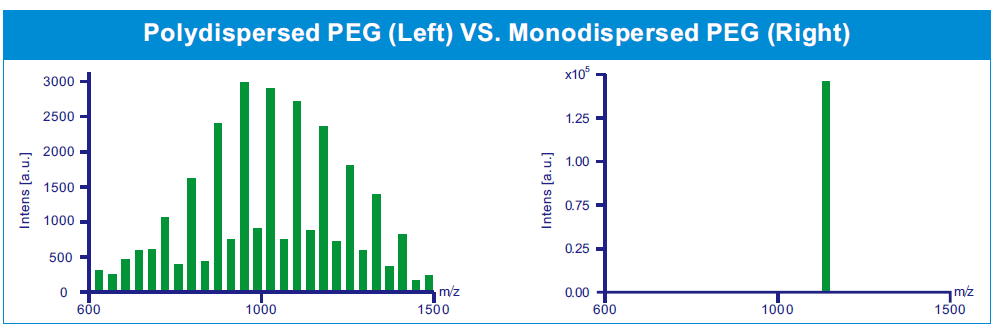
Monodispersed PEG
Monodispersed PEGs are chemically well-defined compounds with a single, precise molecular weight and a uniform number of ethylene oxide repeat units. They typically have molecular weights less than 1000 Da (e.g., 2 to 72 repeating units) and exhibit a polydispersity index (PDI) close to 1.0. Owing to their high molecular weight precision and batch-to-batch consistency, monodispersed PEGs are preferred in applications that demand strict structural control, such as site-specific drug conjugation, precise bioconjugation, and advanced laboratory synthesis.
Polydispersed PEG
Polydispersed PEGs are polymer mixtures characterized by a broader molecular weight distribution, with PDI values greater than 1.0. They are commonly described by an average molecular weight (e.g., PEG 5K, PEG 10K) and typically span a molecular weight range of approximately 1,000–40,000 Da. Due to their lower production cost and broad availability, polydispersed PEGs are widely used in industrial manufacturing, formulation development, and routine research applications where ultra-high molecular precision is not required.
Classification by Functional End Groups
Reactive Functional Groups
Reactive PEG derivatives are designed to introduce covalent linkages between PEG and biological molecules—such as proteins, peptides, or nucleic acids—through selective reactions with functional moieties including amines, thiols, and carboxyl groups. This controlled conjugation enables PEGylation to improve molecular stability, solubility, and pharmacokinetic behavior. Common reactive groups and their typical applications include:
| PEG Linker | Reactive Target | Description & Applications |
| NHS Ester (NHS) | Primary amines (–NH₂) | Efficiently reacts under neutral to slightly basic conditions. Widely used for protein PEGylation, e.g., mPEG–NHS modification of interferons to extend circulation half-life. |
| Carboxylic Acid (–COOH) | Amines (after activation) | Requires activation (e.g., EDC/NHS) to form stable amide bonds. Widely used for controlled PEG–protein, PEG–peptide, and PEG–surface conjugation. |
| Maleimide (MAL) | Thiols (–SH) | Enables site-specific conjugation, commonly applied in antibody–drug conjugates (ADCs) for cysteine residues. |
| Thiol (SH) | Maleimides, disulfides, haloacetyls | Supports site-specific conjugation and surface modification of proteins, polymers, or gold nanoparticles. |
| Aldehyde (–CHO) | Hydrazides / Amines | Reacts with hydrazide or aminooxy groups to form hydrazone or oxime linkages under mild aqueous conditions. Suitable for site-selective labeling of oxidized glycoproteins. |
| Azide (N3) | Alkynes (via CuAAC) or aryl phosphines (Staudinger ligation) | Highly selective and stable; ideal for pH-sensitive systems or multi-step bioconjugation in click chemistry. |
| Alkyne / DBCO | Azides (copper-free click chemistry) | Strain-promoted cycloaddition allows copper-free reactions. PEG spacer improves solubility and biocompatibility; works in aqueous or organic media. |
| Hydrazide | Aldehydes / Ketones | Forms hydrazone bonds under mild aqueous conditions. Suitable for site-specific labeling of oxidized sugar moieties on antibodies, proteins, or polysaccharides. |
Targeting Functional Groups
Targeting PEG derivatives are designed to confer molecular recognition capability by introducing biologically active ligands that enable selective accumulation in specific tissues or cell types. This active targeting strategy enhances drug delivery efficiency while reducing off-target exposure and systemic toxicity. Common targeting ligands and representative applications include:
Biotin
Biotin-functionalized PEG exploits the strong and highly specific interaction between biotin and streptavidin. It is widely used in biomolecule immobilization, bioassays, and cellular imaging. For example, biotin–PEG–lipid conjugates are commonly employed to label nanoparticles, facilitating in vivo tracking and biodistribution studies.
RGD Peptide (Arg-Gly-Asp)
RGD-containing PEG derivatives selectively bind to integrin receptors expressed on cell surfaces, particularly those overexpressed on tumor neovasculature. They are frequently used in tumor-targeted drug delivery systems, such as RGD-PEG-liposomes designed to deliver chemotherapeutic agents directly to tumor sites, thereby enhancing local efficacy.
Folic Acid (Folate)
Folic Acid-functionalized PEG targets cells with high expression of folate receptors, which are commonly upregulated in certain cancers, including ovarian and lung tumors. A typical application is Folic Acid-PEG-paclitaxel nanoparticles, which enable selective recognition of tumor cells and reduce cytotoxic effects on healthy tissues.
Applications of PEG Linkers
PEGylation has been used clinically for drug half-life extension for more than 30 years and has become one of the most established and reliable strategies for long-acting drug design due to PEG’s favorable physicochemical and biological properties. As research has progressed, the application scope of PEG has expanded well beyond traditional peptide and protein modification to include small-molecule drugs, ADC and PROTAC linkers, gene and nucleic acid delivery systems, and PEG-based hydrogels for medical devices.
PEGylation of Protein and Peptide
PEGylation of protein and peptide is the most mature and widely validated application. Covalent attachment of PEG to protein or peptide therapeutics provides steric shielding that reduces immunogenic recognition, limits proteolytic degradation, and helps preserve biological activity. At the same time, PEGylation enables sustained drug release and improved biodistribution, resulting in prolonged circulation half-life and reduced dosing frequency.
PEGylated therapeutics entered clinical development and commercialization in the 1980s. In 1981, Professor Frank Davis founded Enzon Pharmaceuticals in the United States, pioneering PEGylation technology. In 1990, the U.S. FDA approved Adagen®, the world’s first PEGylated drug, for the treatment of severe combined immunodeficiency (SCID). Since then, multiple PEGylated products—including PEG-adenosine deaminase (ADA), interferons (IFN), human growth hormone (hGH), camptothecin (CPT) derivatives, recombinant human granulocyte colony-stimulating factor (rhG-CSF), and L-asparaginase—have been successfully commercialized and widely used in immunology, oncology, and related therapeutic areas.
Biopharma PEG provides integrated PEGylation solutions covering recombinant protein expression, PEG–protein conjugation, purification, and comprehensive analytical characterization. Multiple conjugation chemistries—including aldehyde-, NHS-, and maleimide-based strategies—are supported to ensure flexibility and reproducibility across different molecular designs. These services are suitable for both preclinical and clinical-stage drug development.
Small-Molecule Drug Modification
Conjugation of PEG to small-molecule drugs can substantially improve their physicochemical and pharmacokinetic properties, including enhanced aqueous solubility, reduced systemic toxicity, prolonged circulation half-life, and improved chemical stability. PEG attachment can also impart a degree of passive or active targeting, depending on the linker design and molecular architecture.
In 2014, AstraZeneca’s PEGylated naloxol derivative, Movantik® (naloxegol), received approval from the U.S. FDA, becoming the first PEGylated small-molecule drug to reach the market. Movantik is indicated for the treatment of opioid-induced constipation in adults with chronic non-cancer pain. Its clinical success validated the feasibility and therapeutic value of PEGylation as a strategy for optimizing small-molecule drugs.
Drug Delivery Systems
PEGylation is a critical enabling technology for the delivery of gene-based therapeutics, including siRNA, mRNA, and plasmid DNA (pDNA). Among non-viral vectors, lipid nanoparticles (LNPs) have emerged as the dominant platform for mRNA delivery, with PEG playing a central role as a key formulation component.
LNPs are self-assembled from ionizable lipids, neutral helper lipids, and cholesterol to form a lipid core, while PEG-conjugated phospholipids are incorporated on the particle surface. Surface PEGylation increases hydrophilicity, enhances colloidal stability, and reduces nonspecific interactions with serum proteins, thereby minimizing rapid clearance by the immune system and prolonging systemic circulation.
In currently approved mRNA vaccines, PEG–lipid components are well established. Pfizer–BioNTech’s COVID-19 vaccine employs the proprietary PEG lipid ALC-0159 (MDT-DAM-2000), while Moderna’s vaccine uses PEG2000-DMG (M-DMG-2000). Both are PEG-2000–based lipid derivatives optimized for LNP stability and in vivo performance.
PEG also plays a pivotal role in siRNA delivery. Due to their relatively large molecular size and strong negative charge, siRNA molecules cannot readily cross cell membranes and are susceptible to degradation within endo-lysosomal compartments. PEGylated polymeric or lipid nanoparticles improve membrane translocation, increase intracellular accumulation, and enhance endosomal escape, ensuring effective gene silencing. In the FDA-approved siRNA drug Onpattro®, a short-chain diacyl PEG lipid (PEG-carbamate-1,2-dimyristoyl-sn-glycerol, PEG-c-DMG) is used. This PEG lipid rapidly dissociates from the LNP after administration, enabling the particle to bind apolipoprotein E (ApoE) in circulation and achieve targeted delivery to hepatocytes.
Biopharma PEG has established industrial-scale manufacturing capabilities for LNP excipients and offers a portfolio of specialized materials, including PEG lipids, DSPE, and plant-derived cholesterol, etc.
ADC and PROTAC Drug Linkers
1. ADC Linkers
PEG is one of the most widely used linker components in antibody–drug conjugates (ADCs). Its key advantages include improved overall aqueous solubility of the ADC—addressing the poor solubility of many cytotoxic payloads—moderate enhancement of the drug-to-antibody ratio (DAR) to increase efficacy while maintaining acceptable toxicity, and prolonged systemic circulation half-life.
Since 2019, ADCs have entered a period of accelerated regulatory approvals, with more than 23 ADC drugs currently approved worldwide. Several marketed products incorporate PEG-derived linkers. For example, sacituzumab govitecan (Trodelvy) uses a cleavable maleimide linker containing short PEG units to conjugate the payload SN-38, while loncastuximab tesirine (ZYNLONTA)employs a maleimide–PEG8 linker to connect the antibody to the highly potent PBD payload SG319. These examples demonstrate the critical role of PEG linkers in balancing solubility, stability, and therapeutic performance in ADC design.
2. PROTAC Linkers
PEG is also a preferred linker scaffold in proteolysis-targeting chimeras (PROTACs). Compared with conventional small-molecule inhibitors, PROTAC technology offers distinct advantages in potency, selectivity, the ability to target previously “undruggable” proteins, and the potential to overcome drug resistance, making it a major focus in current drug discovery.
According to Current Strategies for the Design of PROTAC Linkers: A Critical Review, approximately 54% of reported PROTAC molecules utilize PEG-based linkers, including representative compounds such as MZ-001 and ARV-825. PEG linkers contribute to PROTAC optimization in several ways:
(1) they improve aqueous solubility and cellular permeability, supporting oral bioavailability;
(2) their tunable chain length allows systematic control of linker geometry, which directly influences target protein degradation efficiency; and
(3) bifunctional PEG linkers enable rapid assembly of PROTAC molecules with different binding moieties, accelerating structure–activity relationship studies and lead optimization.
Hydrogel-Based Medical Devices
Owing to its excellent biocompatibility, PEG has found expanding applications in the medical device field, with multi-arm PEG derivatives serving as the core functional materials. These high–molecular weight PEGs can be crosslinked to form hydrogels that combine strong water-retention capability with favorable tissue interactions. They undergo gradual degradation in vivo and are ultimately eliminated from the body, resulting in a high level of safety.
PEG-based hydrogels are used in a wide range of medical applications, including hemostatic and tissue-separation gels for surgical procedures and as adjuncts in tumor radiotherapy; absorbable implantable systems for sustained drug release; and injectable or implantable hydrogels for ophthalmic therapies, antimicrobial treatments, and angiogenesis-promoting self-healing materials. Additional applications include wound dressings for diabetic skin repair and three-dimensional matrices for cell culture and tissue engineering.
Biopharma PEG is A Leading PEG Supplier
Biopharma PEG (Biochempeg) , a worldwide leader of PEG linkers, offers a wide array of 5,000 PEG derivatives, covering monodispersed and polydispersed structures with molecular weights ranging from 200 to 4w. These compounds feature great aqueous solubility, a smart choice of PEG length, and a broad selection of functional groups to choose from. Contact us at [email protected] for more details.
References:
[1] Mansour, F.R., Zhou, L. & Danielson, N.D. Applications of Poly(Ethylene)Glycol (PEG) in Separation Science. Chromatographia 78, 1427–1442 (2015). https://doi.org/10.1007/s10337-015-2983-y
[2] Gao Y, Joshi M, Zhao Z, Mitragotri S. PEGylated therapeutics in the clinic. Bioeng Transl Med. 2023 Sep 22;9(1):e10600. doi: 10.1002/btm2.10600. PMID: 38193121; PMCID: PMC10771556.
[3] Christoforou, I., Kalatzis, A., Siamidi, A., Vlachou, M., Pispas, S., & Pippa, N. (2025). The Ubiquitous Use of Polyethylene Glycol in Pharmaceutical Design and Development: Technological Aspects and Future Perspectives. Nanomaterials, 15(23), 1762. https://doi.org/10.3390/nano15231762