Antibody-drug conjugates (ADCs) represent a novel and rapidly evolving class of targeted therapeutics that combine the high specificity of monoclonal antibodies (mAbs) with the potent cytotoxic effects of small-molecule drugs. 15 ADCs are approved by FDA for treating hematological malignancies and solid tumors, demonstrating significant clinical efficacy. Although initially developed for cancer, ADCs are now being explored for the treatment of autoimmune diseases, aiming to selectively deplete pathogenic immune cells.
Related Article: ADCs Beyond Cancer: Emerging Therapeutic Potential
Unlike cancer, where the goal is to eliminate malignant cells, autoimmune diseases require precise regulation of an overactive immune system while preserving normal immune function. This shift is redefining the role of ADCs, from selective cell killing to selective immune modulation, making autoimmune ADCs one of the most closely watched emerging areas in drug development.
Three Stages of Autoimmune Disease Treatment
The treatment of autoimmune diseases has evolved through three distinct stages.
Stage 1: Broad Immunosuppressants
Early treatment relied primarily on glucocorticoids and conventional immunosuppressants like cyclophosphamide, azathioprine, and cyclosporine. While these therapies effectively control inflammation, long-term systemic exposure is associated with significant adverse effects, including osteoporosis, metabolic disorders, and endocrine complications.
Stage 2: Targeted Immunotherapies - Block Inflammatory Signaling Pathways
The introduction of biologics and targeted small molecules against TNF, IL-6, IL-17, JAK, BTK, FcRn, and other immune pathways marked a major advance in autoimmune disease management. These therapies offer greater specificity than conventional immunosuppressants, but many patients still require continuous treatment, and disease relapse after discontinuation remains a significant challenge.
Stage 3: Cell-Selective Intervention and Immune Resetting
The latest generation of therapies aims to selectively eliminate or reprogram disease-driving immune cells. Approaches such as CD19 CAR-T cell therapy, B-cell depletion, plasma cell-targeted therapies, and T-cell engagers (TCEs) seek to remodel the pathogenic immune system and achieve durable, treatment-free remission.
ADCs in Autoimmune Diseases: From Targeted Cell Killing to Precision Immune Modulation
Although ADCs in autoimmune diseases are built on the same core technology platform as conventional ADCs, their therapeutic design principles are fundamentally different.
In oncology, ADC payloads are highly potent cytotoxins, but in autoimmune diseases, they may selectively eliminate autoreactive immune cells or modulate their activity. For example, delivering apoptosis-inducing agents to autoreactive B cells or using immunomodulatory payloads to inhibit signaling pathways can achieve precise immune suppression, minimizing the side effects of conventional drugs.
ADCs in autoimmune diseases focus on targeting specific immune cells, such as B cells and plasma cells, with markers like CD19, CD20, CD22, BCMA, and CD38, etc.
Advantages of Autoimmune ADCs
Against this backdrop, autoimmune ADCs occupy a unique position between conventional biologics and advanced cell therapies, combining targeted delivery with the potential for enhanced therapeutic efficacy.
Compared with conventional immunosuppressants: ADCs enable targeted delivery of potent therapeutic agents, reducing systemic exposure, minimizing off-target toxicity and reducing variable patient responses due to broad immune suppression.
Compared with monoclonal antibodies and small molecules: ADCs combine the target specificity of antibodies with the intracellular activity of small-molecule therapeutics. By delivering potent payloads directly into selected immune cells, they offer the potential to improve efficacy while limiting systemic adverse effects.
Compared with CAR-T cell therapy: ADCs are off-the-shelf biologic drugs that can be manufactured at scale and administered in the outpatient setting. Unlike CAR-T therapies, they do not require individualized cell manufacturing or hospitalization and carry a substantially lower risk of cytokine release syndrome (CRS) and immune effector cell-associated neurotoxicity syndrome (ICANS).
Compared with T-cell engagers (TCEs): ADCs do not rely on T-cell redirection to eliminate target cells. As a result, they may present a lower risk of excessive immune activation and off-target toxicity, while providing a more controlled mechanism of action.
Together, these characteristics position autoimmune ADCs as a promising therapeutic modality that bridges the gap between established biologics and next-generation cell therapies.
Emerging ADCs in Clinical for Autoimmune Diseases
Although autoimmune ADCs remain at an early stage of development, several promising candidates have already advanced into clinical evaluation, providing important insights into the potential of this emerging therapeutic approach.
Systemic Lupus Erythematosus (SLE)
DB-2304 (Duality Biologics) is one of the leading autoimmune ADC candidates for SLE. The ADC targets BDCA2, a receptor selectively expressed on plasmacytoid dendritic cells (pDCs), the primary producers of type I interferons. By delivering a glucocorticoid receptor agonist directly to these cells, DB-2304 is designed to suppress abnormal interferon signaling at its source while minimizing systemic immunosuppression.
Phase I data demonstrated that a 1 mg/kg dose administered every four weeks (Q4W) maintained more than 95% receptor occupancy, with an approximately 10-day half-life and a favorable safety profile. The program has since advanced into Phase II clinical studies in the United States and Australia. [4]
Rheumatoid Arthritis (RA)
ABBV-3373, developed by AbbVie, was the first autoimmune ADC to demonstrate the clinical feasibility of combining a monoclonal antibody with a glucocorticoid payload. Although the program was later discontinued as part of AbbVie's portfolio strategy, it provided important proof of concept for targeted glucocorticoid delivery.
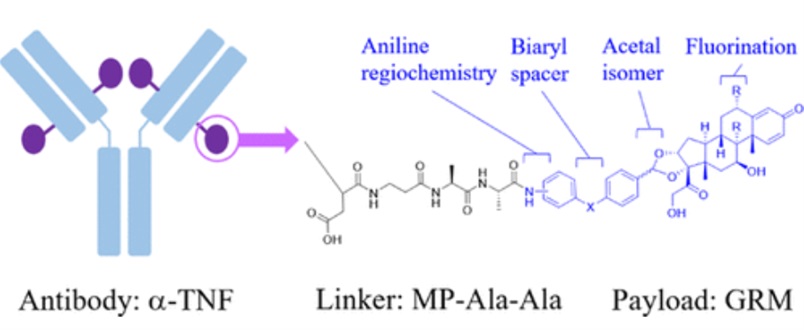
Structure of ABBV-3373, Journal of Medicinal Chemistry 2022, 65, 23, 15893-15934
Phase II clinical trial (NCT03823391) showed that, compared to adalimumab, ABBV-3373 demonstrated a greater advantage in improving disease activity scores (-2.65 vs. -2.13, P = 0.022) and had a lower incidence of adverse events (35% vs. 71%), providing a new paradigm for the precision application of glucocorticoids.
Another promising candidate, LFD-200, is a glucocorticoid ADC targeting VISTA, an immune checkpoint protein expressed on multiple immune cell populations. The program entered Phase I clinical development in October 2025 for the treatment of rheumatoid arthritis.
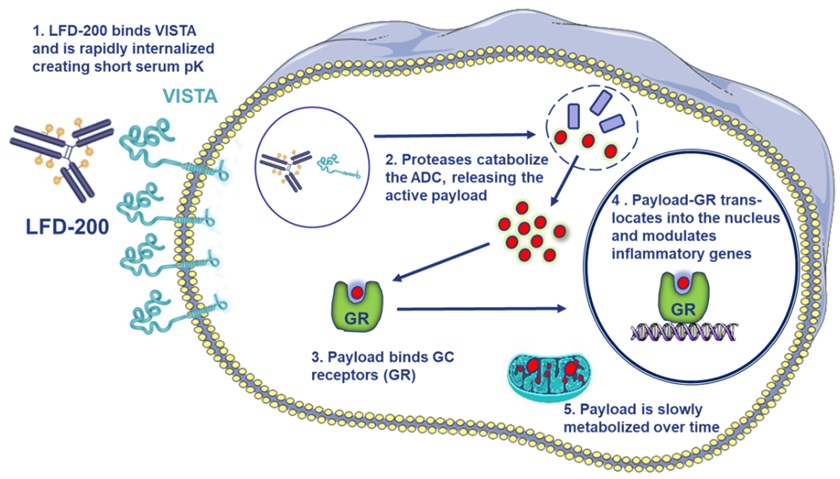
A Schematic of LFD-200 Mechanism of Action, Lifordi Immunotherapeutics official website
LFD-200 uses a modified glucocorticoid payload that is selectively delivered to VISTA-expressing immune cells, concentrating anti-inflammatory activity at disease-relevant sites while minimizing systemic exposure. Phase 1 data from healthy participants (HPs) presented at EULAR 2026 (European Congress of Rheumatology), in London, UK, June 3-6, 2026, showed LFD-200 was well tolerated and demonstrated dose-responsive anti-inflammatory activity with no impact on serum cortisol levels, a sensitive marker for systemic GC toxicity. Dosing patients with moderate to severe rheumatoid arthritis (RA) in the Phase 1 study is ongoing with data expected by year-end 2026. [5]
Beyond RA and SLE, The exploration of ADCs for other autoimmune diseases is also continuously expanding. including atopic dermatitis, asthma, and inflammatory bowel disease (IBD). The growing number of programs across diverse indications highlights the broad therapeutic potential of ADC technology and underscores its emergence as a promising platform for precision immune modulation.
Challenges in Developing ADCs for Autoimmune Diseases
Although ADCs have transformed cancer treatment, applying this technology to autoimmune diseases is far more complex. Unlike cancer, autoimmune diseases usually require long-term or lifelong treatment, and patients are not always facing an immediate life-threatening condition. As a result, autoimmune ADCs must meet much higher standards for safety, selectivity, and long-term tolerability.
Target Selection
Target selection is one of the biggest challenges in autoimmune ADC development. Unlike cancer, autoimmune diseases do not have many disease-specific targets comparable to tumor-specific antigens, making off-target effects a greater concern.
Therefore, an ideal ADC target for autoimmune diseases should meet three key criteria:
(1) high enrichment on pathogenic immune cells;
(2) limited expression on normal immune cells;
(3) efficient internalization to deliver the drug.
Ideally, ADCs need to target autoreactive immune cell subpopulations rather than the entire population of that subset, but reliable surface markers to distinguish these pathogenic and protective subpopulations are currently lacking
Payload Design
Traditional cytotoxic agents such as MMAE and DXd, which dominate oncology ADCs, are giving way to non-cytotoxic payloads, including glucocorticoid (GR) agonists, JAK inhibitors, siRNA, and other oligonucleotide therapeutics. Rather than eliminating immune cells, these payloads are designed to selectively regulate immune function while preserving normal immune homeostasis.
Linker Design and Plasma Stability
Glucocorticoids and many immunomodulatory payloads are highly hydrophobic, increasing the risk of ADC aggregation, nonspecific tissue distribution, and unfavorable pharmacokinetics. To address these challenges, next-generation autoimmune ADCs require linker technologies that combine high hydrophilicity with exceptional stability in circulation, ensuring that payload release occurs only after the ADC reaches its intended target.
Balancing immune system suppression
Autoimmune ADCs must strike a balance between suppressing pathogenic immune responses and maintaining normal immune function. Excessive suppression can increase the risk of infections and malignancies, especially in the context of long-term therapy. This challenge is relatively minor in oncology ADC therapy, as short-term immunosuppression is generally acceptable for patients.
Looking Ahead
The success of ADCs in oncology has demonstrated the tremendous value of antibody-mediated targeted drug delivery. Today, autoimmune diseases represent the next major opportunity for this technology platform.
Unlike oncology ADCs, which are designed to maximize tumor cell killing, autoimmune ADCs focus on precisely modulating dysregulated immune responses while minimizing long-term systemic toxicity. This shift in therapeutic strategy positions autoimmune ADCs as a promising modality that bridges the gap between conventional biologics and advanced cell therapies.
Although the field is still in the early stages of clinical development, growing clinical evidence and continued advances in antibody engineering, linker technology, and payload design are rapidly expanding its potential. As these technologies continue to mature, autoimmune ADCs are expected to become an important area of ADC innovation, offering new therapeutic options for chronic autoimmune diseases such as systemic lupus erythematosus (SLE), rheumatoid arthritis (RA), and inflammatory bowel disease (IBD).
References:
[1] Justiz-Vaillant, A. Antibody–Drug Conjugates (ADCs) and Their Journey to Autoimmune Disease Immunotherapy. Med. Sci. Forum 2025, 40, 2. https://doi.org/10.3390/msf2025040002
[2] Zhou M, Huang Z, Ma Z, Chen J, Lin S, Yang X, Gong Q, Braunstein Z, Wei Y, Rao X, Zhong J. The next frontier in antibody-drug conjugates: challenges and opportunities in cancer and autoimmune therapy. Cancer Drug Resist. 2025 Jul 3;8:34. doi: 10.20517/cdr.2025.49. PMID: 40843358; PMCID: PMC12366496.
[3] Jung SM, Kim WU. Targeted Immunotherapy for Autoimmune Disease. Immune Netw. 2022 Feb 17;22(1):e9. doi: 10.4110/in.2022.22.e9. PMID: 35291650; PMCID: PMC8901705.
[4] http://en.dualitybiologics.com/news/599.html Duality Biologics Orally Presents Phase 1 Healthy Volunteer Data for First-in-Class BDCA2-Targeted ADC DB-2304 at Autumn Immunology Conference 2025
[5] https://lifordi.reportablenews.com/pr/lifordi-immunotherapeutics-presents-phase-1-clinical-data-for-lfd-200-a-subcutaneous-glucocorticoid-antibody-drug-conjugate-at-eular-2026