As of June 2026, 23 antibody-drug conjugate (ADC) drugs have been approved worldwide, including products that have been withdrawn from the market. These ADCs target more than 10 antigens, including HER2, TROP2, CD30, CD33, BCMA, EGFR, FRα, Nectin-4, c-Met, and CD123, and are approved for a broad range of cancers, including breast, lung, gastric, and urothelial cancers, as well as lymphoma, leukemia, and multiple myeloma.
Two ADCs received regulatory approval in the first half of 2026 - one in China and one in the United States.
| Date | ADC drug | Company | Target / Indication |
| May 27, 2026 (FDA) | Pivekimab sunirine-pvzy (Decnupaz) | AbbVie | CD123 / Blastic plasmacytoid dendritic cell neoplasm (BPDCN) |
| Jun 22, 2026 (NMPA) | Izalontamab brengitecan (iza-bren; BL-B01D1) | Biokin Pharma/SystImmune/BMS | EGFR × HER3 bispecific antibody / nasopharyngeal cancer |
Table 1. Two Approved ADCs in 2026
Two Approved ADCs in 2026
Izalontamab Brengitecan: The First Approved Bispecific ADC
On June 22, 2026, China's National Medical Products Administration (NMPA) granted conditional approval under the priority review pathway to izalontamab brengitecan for the treatment of adults with recurrent or metastatic nasopharyngeal carcinoma (NPC) whose disease has progressed after at least two lines of systemic chemotherapy and prior treatment with a PD-1/PD-L1 inhibitor.
Izalontamab brengitecan is a first-in-class EGFR/HER3 bispecific ADC, consists of a bispecific IgG1 antibody conjugated to a topoisomerase I inhibitor payload (Ed-04) through a cleavable linker, with a high drug-to-antibody ratio (DAR) of 8. By simultaneously targeting EGFR and HER3, the ADC is designed to enhance tumor-cell binding and internalization and deliver its cytotoxic payload to tumor cells, including those with relatively low receptor expression.
The approval was supported by results from the phase 3 PANKU-NPC01/BL-B01D1-303 trial (NCT06118333). Patients treated with iza-bren achieved a confirmed overall response rate (ORR) of 54.6% (95% CI, 45.2%-63.8%), compared with 27.0% (95% CI, 19.1%-36.0%) for investigator’s choice of chemotherapy (OR, 3.3; 95% CI, 1.9-5.8; P < .0001). The median duration of response (DOR) was 8.5 months with iza-bren versus 4.8 months with chemotherapy (HR, 0.43; 95% CI, 0.22-0.83). Median progression-free survival (PFS) was 8.38 months versus 4.34 months, respectively (HR, 0.44; 95% CI, 0.32-0.62). Overall survival (OS) data were not yet mature at the time of the analysis. [1]
Just 25 days later, on July 17, 2026, the NMPA approved iza-bren for a second indication: the treatment of adults with recurrent or metastatic esophageal squamous cell carcinoma (ESCC) whose disease has progressed following platinum-based chemotherapy and PD-1/PD-L1 inhibitor therapy. [2]
The approval was based on results from the pivotal PANKU-Esophagus01 (BL-B01D1-305) study.
- ● Median OS: 9.8 months with iza-bren vs 7.2 months with chemotherapy (HR, 0.64; 95% CI, 0.49-0.83; P = .0004)
- ● Median PFS: 4.2 months vs 2.0 months, respectively, based on blinded independent central review (HR, 0.50; 95% CI, 0.40-0.63; P < .0001)
Decnupaz: ADC for Ultra-Rare Blood Cancer
On May 27, 2026, the FDA approved Decnupaz (pivekimab sunirine-pvzy), developed by AbbVie, for the treatment of blastic plasmacytoid dendritic cell neoplasm (BPDCN). It is the first ADC approved for BPDCN.
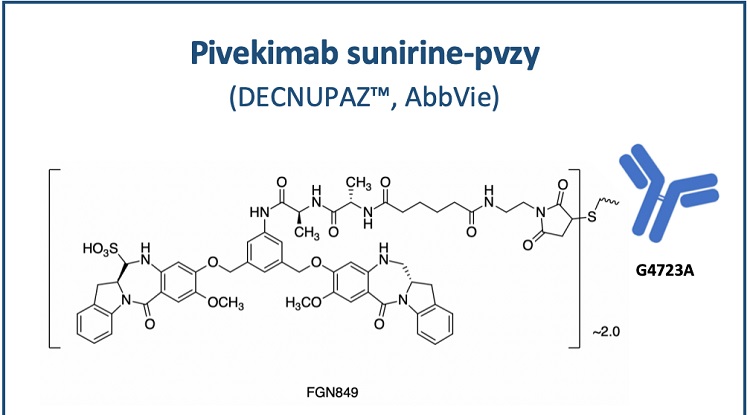
Figure 1. Structure of Decnupaz
Pivekimab sunirine-pvzy is a CD123-directed antibody and alkylating agent conjugate created by conjugating the IgG1 monoclonal antibody G4723A to the DGN549C linker-payload. Pivekimab sunirine-pvzy binds to CD123 expressing cells and upon intracellular processing releases a cell membrane-permeable payload, FGN849, leading to DNA alkylation, single-strand DNA breaks, apoptosis, and cell death.
The approval was primarily supported by data from the Phase 1/2 CADENZA trial. Among newly diagnosed BPDCN patients (n=33), Decnupaz produced clinically meaningful and durable responses, with a composite complete response rate of 69.7% and a median duration of response of 9.7 months. Notably, 13 patients (39.4%) went on to receive stem cell transplantation following treatment with Decnupaz.
In relapsed or refractory BPDCN patients (n=51), the composite complete response rate was 15.7%, with a median duration of response of 9.2 months. Six patients (11.8%) subsequently underwent stem cell transplantation after treatment. [3]
Key Trends to Watch
Bispecific ADCs Enter the Spotlight
The approval of izalontamab brengitecan (iza-bren) marks a new milestone for bispecific ADC development. By engaging two tumor-associated targets simultaneously, bispecific ADCs may improve tumor-cell selectivity, enhance internalization, and potentially broaden the therapeutic window.
CD123 Moves to Clinical
The approval of Decnupaz represents the first CD123-targeted ADC therapies, demonstrating the potential of CD123-directed ADCs in hematologic malignancies, particularly in diseases with limited treatment options.
ADCs Continue to Expand Beyond Conventional Solid Tumors
The approval of Decnupaz also highlights the broadening clinical reach of ADC into hematologic malignancies and rare cancers.
ADC Pipeline Remains Active
Beyond the two ADCs already approved in the first half of 2026, ifinatamab deruxtecan (I-DXd) is also advancing through the U.S. regulatory process.
On April 13, 2026, Daiichi Sankyo and Merck announced that the U.S. FDA has accepted and granted Priority Review to the Biologics License Application (BLA) for ifinatamab deruxtecan for the treatment of adults with extensive-stage small cell lung cancer (ES-SCLC) whose disease has progressed on or after platinum-based chemotherapy. The FDA has set October 10, 2026, as the PDUFA action date for its regulatory decision. [4]
Ifinatamab deruxtecan is a potential first-in-class B7-H3 directed DXd ADC. The ADC is designed to selectively target B7-H3, a protein highly expressed across a range of solid tumors, and deliver DXd topoisomerase I inhibitor payload to tumor cells.
Conclusion
With new approvals targeting EGFR/HER3 and CD123, ADCs are moving beyond conventional single-target approaches and expanding into bispecific formats, hematologic malignancies, and rare cancers.
At the same time, candidates such as ifinatamab deruxtecan continue to advance through regulatory review, highlighting the strength of the ADC pipeline. As new targets, payloads, and antibody designs continue to emerge, ADCs are likely to remain a major focus of innovation in oncology and a key area of growth in the biopharmaceutical industry.
Biopharma PEG, as a leading PEG linker supplier, provides a range of PEG linker technologies and customized PEG derivatives that support the development of next-generation ADCs and other targeted bioconjugates.
References:
[1] https://www.onclive.com/view/iza-bren-is-approved-in-china-for-recurrent-metastatic-nasopharyngeal-carcinoma Iza-Bren Is Approved in China for Recurrent/Metastatic Nasopharyngeal Carcinoma
[2] https://www.biospace.com/press-releases/systimmune-announces-second-approval-of-iza-bren-in-china-for-the-treatment-of-recurrent-or-metastatic-esophageal-squamous-cell-carcinoma Approval of Iza-bren in China for the Treatment of Recurrent or Metastatic Esophageal Squamous Cell Carcinoma
[3] https://news.abbvie.com/2026-05-27-U-S-FDA-Approves-DECNUPAZTM-pivekimab-sunirine-pvzy-for-Treatment-of-Adult-Patients-with-Blastic-Plasmacytoid-Dendritic-Cell-Neoplasm,-an-Ultra-Rare-and-Aggressive-Blood-Cancer-With-Limited-Treatment-Options U.S. FDA Approves DECNUPAZ™ (pivekimab sunirine-pvzy) for Treatment of Adult Patients With Blastic Plasmacytoid Dendritic Cell Neoplasm, an Ultra-Rare and Aggressive Blood Cancer With Limited Treatment Options
[4] https://daiichisankyo.us/press-releases/-/article/ifinatamab-deruxtecan-granted-priority-review-in-the-us-for-adult-patients-with-previously-treated-extensive-stage-small-cell-lung-cancer-who-experienced-disease-progression-on-or-after-platinum-based-chemotherapy