Maleimide-PEG is a thiol-reactive PEG derivative used to connect polyethylene glycol (PEG) chains with proteins, peptides, antibodies, and other molecules containing accessible sulfhydryl groups. The maleimide end reacts primarily with thiols, particularly the cysteine residues in biomolecules, forming a covalent thioether linkage under relatively mild conditions.
This combination gives Maleimide-PEG a useful role in bioconjugation. PEG can alter a molecule's hydrodynamic size, solubility, surface properties, and interactions with its surrounding environment, while the maleimide group provides a practical route for attaching the polymer at a thiol-containing site.
The choice of Maleimide-PEG is not simply a matter of selecting a reactive end group. PEG molecular weight, polymer architecture, thiol accessibility, conjugation conditions, and linkage stability all affect the final product. These considerations become especially important when developing a conjugate for therapeutic use.
What Is Maleimide-PEG?
Maleimide-PEG is a PEG derivative containing a maleimide functional group at one end or at a defined position in its molecular structure. The maleimide group provides the thiol-reactive site, while the PEG chain contributes hydrophilicity and a flexible polymer spacer.
Several structural formats are used in bioconjugation:
| Linker Architecture | Structural Profile | Key Technical Advantages | Typical Bioconjugation Roles |
| Linear mPEG-Maleimide | Monomethoxy PEG chain with a single terminal maleimide | Broad molecular weight options, well-established PK/clearance behavior, straightforward single-site attachment | Half-life extension of peptides, proteins, and engineered fragments |
| Homo/Heterobifunctional PEG-MAL | PEG bismaleimide or MAL-PEG-X (e.g., X = NHS, COOH, NH2, Azide, Biotin, or lipid anchors) | Supports sequential, orthogonal conjugation between two different molecules | Targeted nanocarriers, conjugate vaccines, dual-labeled probes, and bi-specifics |
| Monodisperse PEG-MAL | Single defined oligomer length (e.g., PEG2 – PEG48) | Exact molecular weight, crisp LC-MS/HPLC peaks, predictable spacing distance | Linker/spacer tuning, ADCs/PDCs, probes, and analytical standards |
| Branched / Y-Shaped PEG-MAL | Two PEG branches converging on a single maleimide group | Larger hydrodynamic radius and stronger steric shielding per unit molecular weight than linear chains | Enhancing enzymatic protection and circulation time on compact payloads |
| Multi-Arm PEG-Maleimide | 4-arm or 8-arm PEG bearing multiple maleimides | Enables 3D network cross-linking and multivalent ligand presentation | Hydrogel matrices, tissue engineering scaffolds, and multivalent surfaces |
Thiol-Maleimide for Site-Specific Conjugation
The central reaction behind Maleimide-PEG conjugation is the Michael-type addition between a maleimide group and a thiol. A free sulfhydryl group, commonly from a cysteine residue, adds across the carbon–carbon double bond of the maleimide ring. This forms a thiosuccinimide linkage and connects the PEG chain to the target molecule.
Thiol-maleimide Michael addition provides rapid, chemoselective thioether bond formation under mild aqueous conditions (pH range of approximately 6.5–7.5) without requiring external catalysts. Compared with amine-reactive esters (such as NHS esters) that often react across multiple surface lysines and generate heterogeneous positional isomers, targeting engineered or reduced cysteines allows cleaner site-specific conjugation when sequence and folding permit.
Simplified reaction:
Maleimide-PEG + R-SH → PEG-thiosuccinimide-S-R
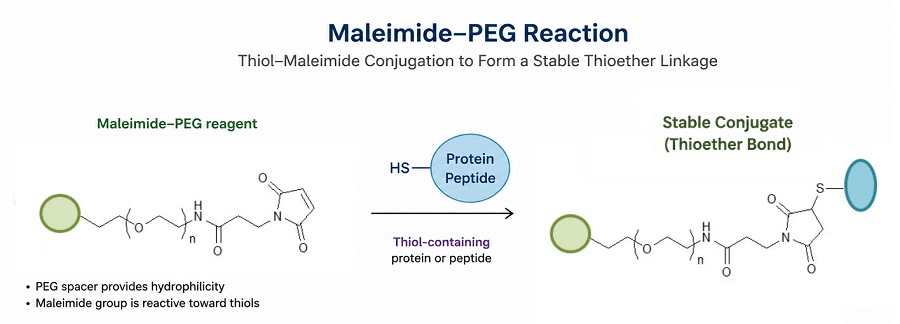
Figure 1. Maleimide reaction scheme for chemical conjugation to a sulfhydryl
Maleimide-PEG Applications
| Site-Specific Protein PEGylation
Protein PEGylation is one of the best-established applications of Maleimide-PEG. The approach is particularly useful when a protein contains a free cysteine residue at a defined position or has been engineered to introduce one.
Compared with less selective modification strategies, cysteine-directed PEGylation can provide better control over the attachment site. This is important because the position and number of PEG chains may affect protein activity, receptor binding, solubility, aggregation behavior, and pharmacokinetics.
A well-known clinical example is certolizumab pegol (Cimzia). Cimzia is a recombinant, humanized antibody Fab' fragment that binds tumor necrosis factor alpha (TNF-α). Its Fab' fragment is conjugated to approximately 40 kDa PEG2MAL40K (composed of two 20 kDa PEG chains). The PEG is attached through a cysteine residue at the C-terminal region of the heavy chain, commonly identified as Cys227. The resulting conjugate has an approximate molecular weight of 91 kDa. PEGylation increases the hydrodynamic size of the Fab' fragment and helps extend its circulation time.
Jivi (damoctocog alfa pegol) provides another important example of Maleimide-PEG in an approved therapeutic protein. Jivi is produced by site-specific conjugation of the BDD-rFVIII variant K1804C at the cysteine amino acid position 1804 (within the A3 domain) with a single maleimide-derivatized, 60 kilodalton (kDa) branched PEG (two 30 kDa PEG) moiety.
| Peptide PEGylation
Maleimide-PEG can be used to modify peptides containing a free cysteine residue, including peptides with an intentionally introduced terminal cysteine.
For peptide development, PEG attachment may help adjust hydrodynamic size, improve apparent solubility, reduce susceptibility to certain degradation pathways, or modify exposure in vivo. The actual effect depends on the peptide sequence, PEG size, conjugation site, and biological system.
Visepegenatide (PB-119) is a once-weekly, long-acting GLP-1 receptor agonist (GLP-1 RA) engineered by covalently attaching a 23 kDa PEG chain to an exenatide peptide backbone, that prolongs the half-life of exenatide in the circulation by increasing the relative molecular mass and decreasing the renal clearance rate.
Related Articles: The Application of PEGs in Long-Acting Peptides
| ADC Linker Design
Maleimide-PEG linkers are used in antibody-drug conjugates (ADCs) to connect antibodies with cytotoxic payloads. The maleimide group reacts with thiol groups on cysteine residues through Michael addition. These thiols can be exposed by partial reduction of interchain disulfide bonds using reagents such as TCEP or DTT. Compared with lysine-based conjugation, cysteine-directed coupling offers better control over conjugation sites, although the resulting drug-to-antibody ratio (DAR) distribution depends on the antibody and reduction conditions.
A clinical example is loncastuximab tesirine (Zynlonta), an FDA-approved CD19-directed ADC conjugated loncastuximab to the pyrrolobenzodiazepine-like (PBD) dimer SG3199 via a valine-alanine (M-PEG8-VA-PABC) linker. Engineered with proteolytic susceptibility, this linker facilitates site-specific drug release within targeted cellular microenvironments, thereby optimizing therapeutic efficacy while minimizing systemic toxicity.
One challenge of conventional maleimide-thiol conjugation is the potential for retro-Michael reaction and subsequent thiol exchange with plasma components, which may cause premature payload loss. Hydrolysis of the thiosuccinimide ring after conjugation can improve linkage stability by reducing susceptibility to thiol exchange. This makes linker design and conjugation conditions important considerations in Maleimide-PEG-based ADC development.
Related Articles: Review: Hydrophilic linkers in Antibody-drug Conjugates
| Targeted LNPs and In Vivo CAR-T Delivery
Maleimide-functionalized PEG-lipids, such as DSPE-PEG-MAL, are used to attach targeting ligands to lipid nanoparticles (LNPs). In this structure, DSPE anchors the PEG-lipid within the lipid nanoparticle, PEG provides a hydrophilic spacer, and the terminal maleimide group serves as a reactive site for thiol conjugation. This allows antibodies or other thiol-containing ligands to be attached to the LNP surface through maleimide-thiol coupling.
A typical approach involves incorporating DSPE-PEG-MAL during LNP formulation or introducing it through a post-insertion process. Thiol groups on targeting antibodies can be exposed by partial reduction or introduced using thiolation reagents such as SATA. These thiols then react with the maleimide groups on the LNP surface. This strategy has been demonstrated in antibody-targeted LNP systems, including anti-CD4- and anti-CD3-functionalized nanoparticles for mRNA delivery to T cells.
An emerging application is in vivo CAR-T cell engineering. In a preclinical study, researchers used anti-CD5-targeted LNPs to deliver mRNA encoding a fibroblast activation protein (FAP)-specific CAR directly to T cells in mice. The engineered T cells showed antifibrotic activity in a cardiac fibrosis model, demonstrating the potential of targeted LNPs for generating CAR-expressing T cells in vivo without conventional ex vivo cell engineering.
Related Articles: The Application of PEGs in Long-Acting Peptides
| Oligonucleotide and Nucleic Acid Conjugation
Thiol-modified oligonucleotides can provide a defined attachment site for Maleimide-PEG. In this design, a terminal or otherwise accessible thiol on an oligonucleotide reacts with the maleimide end of PEG, producing a PEG-modified nucleic acid conjugate.
This approach may be considered in the development of modified antisense oligonucleotides, siRNA, aptamers, and other nucleic acid constructs. The PEG segment can serve as a hydrophilic spacer or as part of a larger molecular assembly.
| Nanoparticle Surface Functionalization
Maleimide-PEG is also used in the surface functionalization of polymeric and other nanocarrier systems. In one common design, PEG is incorporated into a nanoparticle-forming polymer or attached to the particle surface, with maleimide groups exposed at the end of the PEG chains.
Thiol-containing ligands, such as cysteine-modified peptides or proteins, can then be coupled to these surface maleimide groups. This creates a PEG-spaced ligand layer that can be used to modify particle recognition or biological interactions.
For example, Maleimide-PEG-functionalized PLGA nanoparticles have been used to attach cysteine-containing targeting peptides such as S2P, as well as ligands including cRGDfK and nanobodies. These studies demonstrate how maleimide-thiol chemistry can be used to introduce targeting molecules onto polymeric nanoparticle surfaces.
In these systems, the PEG chain does more than provide a connection point. It also affects how far the ligand extends from the particle surface, how accessible it is to its target, and how the particle interacts with its surrounding environment. PEG length and ligand density should therefore be considered together.
| Bioconjugation and Molecular Assembly
Heterobifunctional Maleimide-PEG can connect a thiol-containing biomolecule to a second component through the opposite PEG terminus. Depending on the terminal group, the second coupling step may involve an amine, carboxyl group, or another compatible functional handle.
This format is useful in the preparation of protein-labeling reagents, affinity constructs, and other multi-component bioconjugates. PEG provides a spacer between the biomolecule and the attached component, which may help reduce steric interference or improve aqueous compatibility.
Bismaleimide-PEG and multi-arm Maleimide-PEG offer additional options when two or more thiol-containing components need to be connected. In such cases, the number and position of reactive groups should be matched to the intended assembly. Uncontrolled crosslinking can lead to heterogeneous products or aggregation.
How to Select the Right Maleimide-PEG Linkers
Choosing a Maleimide-PEG linker requires more than matching the molecular weight listed in a product specification. The conjugation site, intended application, and analytical requirements all influence the decision.
| PEG Molecular Weight
PEG molecular weight can affect hydrodynamic size, solubility, steric shielding, and circulation behavior. A higher molecular weight PEG may provide greater shielding and increase the apparent hydrodynamic size of a conjugate. However, a larger PEG chain can also interfere with receptor binding or other biological interactions.
| Monodisperse or Polydisperse PEG
The choice between monodisperse and polydisperse PEG depends on the level of molecular definition required.
Monodisperse Maleimide-PEG has a defined molecular weight and is useful when researchers need a more uniform PEG structure for analytical characterization and structure-property studies.
Polydisperse Maleimide-PEG contains a distribution of polymer chain lengths. It may be suitable for applications where a PEG molecular weight distribution is acceptable and the resulting product profile can be adequately characterized.
| Linear or Multi-Arm PEG Architecture
Linear Maleimide-PEG is commonly considered when a single PEG chain is required at a defined cysteine site.
Multi-arm PEG architectures offer a different design option. Depending on the number and position of reactive groups, they may support multivalent conjugation or more complex molecular structures.
However, a multi-arm PEG is not automatically better for site-specific PEGylation. Multiple reactive arms can increase the possibility of heterogeneous products if the drug contains more than one available thiol or if the reaction is not carefully controlled. The architecture should match the intended conjugate design.
| Linker Structure and Functional Group
The chemical structure between PEG and the reactive maleimide group can also influence the final conjugate. Researchers should consider linker length, hydrophilicity, steric environment, and the stability required for the intended application.
Maleimide-PEG Linkers from Biopharma PEG
Biopharma PEG supplies functionalized PEG derivatives for bioconjugation and polymer modification research, including PEG structures designed around different molecular weights, architectures, and terminal functional groups.
At Biopharma PEG, our Maleimide-PEG portfolio is organized to support discovery screening, custom synthesis, and scalable supply across bioconjugation and drug delivery workflows:
- Peptide & Protein Half-Life Extension: Explore Linear mPEG-Maleimide, Heterobifunctional Maleimide-PEG, and Branched Y-Shaped PEG-Maleimide across multiple molecular weights to balance circulation half-life and steric accessibility.
- Defined Spacers, ADCs/PDCs & Orthogonal Conjugation: Browse Discrete Maleimide-PEG Linkers (such as NHS, Azide, Amine, Carboxylic Acid, or Biotin derivatives) for modular assembly and crisp analytical profiles.
- Targeted LNPs, Liposomes & Biomaterial Networks: Review DSPE-PEG2000-MAL & Lipid-PEG-Maleimide Derivatives for nanocarrier surface engineering and Multi-Arm PEG-Maleimide for hydrogel and surface modification.
If you are evaluating a specific peptide, protein, LNP formulation, or hydrogel system and want help selecting a molecular weight, spacer length, or scale-up path from milligram screening to bulk/GMP supply, contact the Biopharma PEG technical team with your target structure and reaction conditions.
References:
1. Dozier JK, Distefano MD. Site-Specific PEGylation of Therapeutic Proteins. Int J Mol Sci. 2015 Oct 28;16(10):25831-64. doi: 10.3390/ijms161025831. PMID: 26516849; PMCID: PMC4632829.
2. Ian W. Hamley; PEG–Peptide Conjugates. Biomacromolecules 12 May 2014; 15 (5): 1543–1559. https://doi.org/10.1021/bm500246w
3. Shaun D. Fontaine, Ralph Reid, Louise Robinson, Gary W. Ashley, Daniel V. Santi; Long-Term Stabilization of Maleimide–Thiol Conjugates. Bioconjugate Chem. 21 January 2015; 26 (1): 145–152. https://doi.org/10.1021/bc5005262
4. Insights into Maleimide–Thiol Conjugation Chemistry: Conditions for Efficient Surface Functionalization of Nanoparticles for Receptor Targeting. Journal of Controlled Release. DOI: 10.1016/j.jconrel.2018.03.002
5. Sheyi R, de la Torre BG, Albericio F. Linkers: An Assurance for Controlled Delivery of Antibody-Drug Conjugate. Pharmaceutics. 2022; 14(2):396.
6. Rurik JG, Tombácz I, Yadegari A, Méndez Fernández PO, Shewale SV, Li L, Kimura T, Soliman OY, Papp TE, Tam YK, Mui BL, Albelda SM, Puré E, June CH, Aghajanian H, Weissman D, Parhiz H, Epstein JA. CAR T cells produced in vivo to treat cardiac injury. Science. 2022 Jan 7;375(6576):91-96. doi: 10.1126/science.abm0594. Epub 2022 Jan 6. PMID: 34990237; PMCID: PMC9983611.
7. Yadav VK, Yadav P, Mallappa S, Neeli P. In Vivo mRNA-Lipid Nanoparticle CAR-T Cell Engineering: Advances, Challenges, and Clinical Translation. Biomedicines. 2026 Jun 3;14(6):1276. doi: 10.3390/biomedicines14061276. PMID: 42351704; PMCID: PMC13296527.